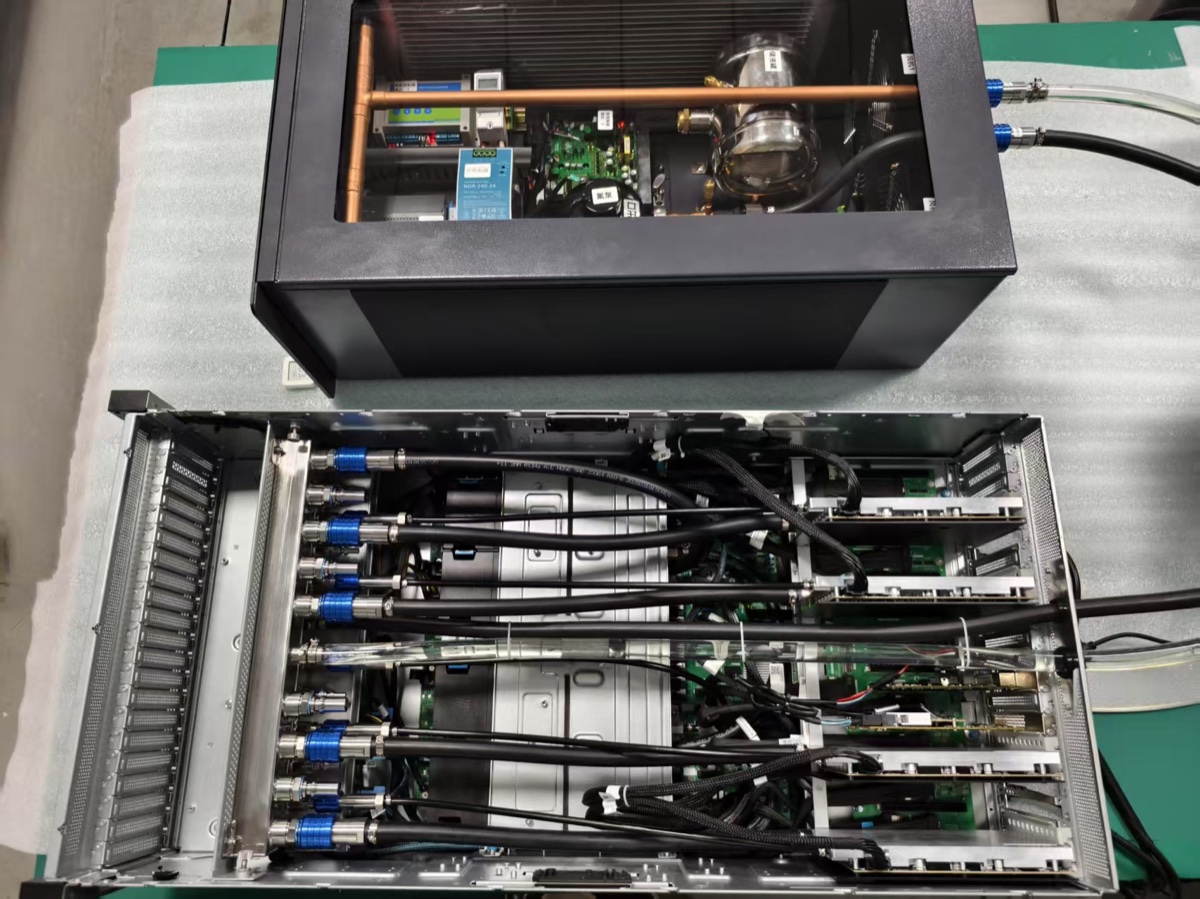
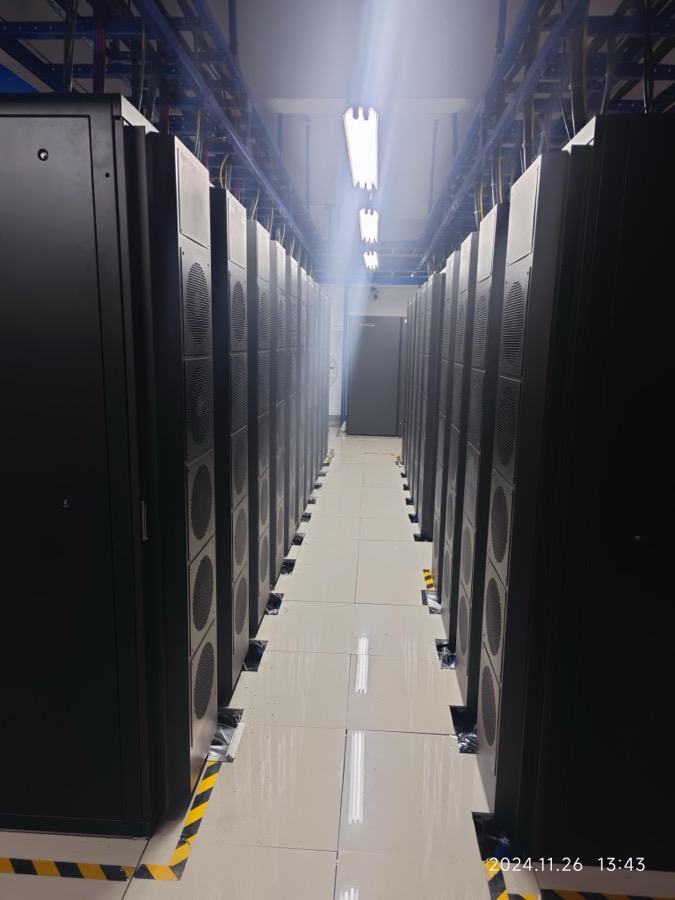
Real Deployments
Aerospace-derived technology that solves the heat dissipation challenge of high-power AI chips — delivering green, efficient, precise and safe cooling for the next generation of data centres.
Pump pressure dynamically controls the boiling point. Liquid enters the microchannels cool, absorbs chip heat through the copper plate, undergoes phase change, and exits as a gas-liquid mixture — all held at ±1.5°C precision across a 25°C–85°C operating range.
Phase change (liquid → vapour) absorbs vastly more heat than temperature rise alone. That's the physics behind every breakthrough in the system.
When a liquid changes to vapour, it absorbs enormous energy at a constant temperature. Our system harnesses this latent heat — refrigerant flows through 0.5mm microchannels directly on the chip surface, boiling and carrying heat away instantly.
By adjusting pump pressure, we dynamically control the boiling point — keeping chip temperatures precisely within the 25°C–85°C operating window, even as compute loads fluctuate from 200W to 600W+ without any flow rate change.
Pump drives liquid refrigerant through 0.5mm microchannels bonded directly to the CPU/GPU surface. Chip heat begins absorbing into the refrigerant.
Refrigerant boils within the channels, absorbing latent heat at constant temperature. The vapour content scales automatically with chip load — no flow adjustment needed.
The liquid-vapour mixture flows to the CDU and outdoor dry cooler. CPU/GPU temps (50–75°C) are higher than ambient, so natural air dissipation works year-round — eliminating chiller energy for most of the year.
As chip load rises from 200W to 600W, the system does not need to pump more coolant. Instead, more refrigerant vaporises inside the cold plate channels — absorbing the extra heat automatically through increased latent heat transfer.
This means no complex flow-rate control valves, no sluggish response time, and no overshooting. The system self-regulates at the physics level — chip temperature stays stable even during sudden compute spikes.
Two-phase cold plates attach directly to each CPU and GPU. The chip-level CDU connects to an outdoor dry cooler. CPU/GPU operating temperatures (50–75°C) are above ambient year-round, so no chiller is required — only a dry cooler for heat rejection.
| Technology | PUE | Equipment Cost | Retrofittable | Leakage Risk | Reliability |
|---|---|---|---|---|---|
| Immersion Cooling | <1.1 | High | No | Low | High |
| Spray Cooling | 1.1 | High | No | Medium | High |
| Single-Phase Cold Plate | 1.25 | Medium | Partial | High | Low |
| ✦ Two-Phase Cold Plate (Ours) | <1.10 | Medium | Yes | None | High |
Source: Beijing TransTrue Technology Co., Ltd. product specification deck, 2025
This technology originated in China's aerospace sector and has been commercially adapted for data centres. The manufacturer holds 8 Chinese invention patents and 1 US patent (via PCT), and has co-authored national cooling standards.
National Standard for Cold Plate Liquid Cooling
National Standard for Liquid Cooling Components for IT Servers
Technical Specification for Pump-Driven Two-Phase Cold Plate Liquid Cooling in Data Centres (Chinese Society of Refrigeration)
Beijing Energy-Saving Technology and Product Directory
Our engineers will assess your facility's heat loads and recommend the right configuration — chip-level, backplane, or dual-loop.